

What's Blocking Your Progress

Updated: Oct 4

Iron palm strength training is just one of many powerful ways to boost your martial arts skills. It builds hand toughness, increases striking power, and improves overall hand conditioning. I’ve seen firsthand how this traditional method transforms fighters and athletes alike. If you want to hit harder and protect your hands, iron palm training is a must. However, it is one piece of a much bigger puzzle
Why Iron Palm Strength Training Matters
Iron palm strength training is not just about brute force. It’s about conditioning your hands to deliver powerful strikes without injury. When you train your palms properly, you develop:
Stronger bones and tendons
Increased pain tolerance
Better hand speed and control
Improved focus and discipline
This training helps you avoid common hand injuries like bruises, fractures, and sprains. It also enhances your confidence when striking. You know your hands can take the impact and keep going.
I don't stop there. I apply the same principles to the entire anatomy. Iron palm and body makes your anatomical weaponry far more powerful but it also makes you far more impervious to injury. The effect of injury on consistent training, sparring, competition and especially real world engagement can be profound.
Many martial artists overlook hand conditioning. They focus on technique but forget that power comes from a solid foundation. Iron palm training fills that gap and iron body makes it complete. It’s a traditional practice used by kung fu masters, martial artists and warriors for centuries.

So then what is blocking your progress in martial arts as a whole ?
I have often spoken of being all in , in your practice of iron palm. But in fact you should be all in in your entire training in martial arts and life. Are you ? Are you a highly dedicated practitioner or a tourist ? Is martial arts an activity to you or a way of life ? Only you can answer those questions and if you find yourself falling short of your expectations then why ? Is it focus, time constraints, consistency, injury, other activities and obligations or a 100 other reasons ? If overall progress has stalled or even gone backwards it generally boils down to one word. Excuses !!
Every athlete has a different training protocol. Even those that have the same instructor or trainer tweek their individual program to suit various objectives. As such if you fall short in any area of that training excuses are at the bottom of it. I retired from active daily teaching many years ago but I never retired from active daily training. My own personal training has been extensive for over five decades and includes many different disciplines. Martial arts, yoga, weight training, iron palm and body , meditation after 55 years they all still play an active role in my way of training.
Just 4% of a 24 hour period is .96 hours. So you should be able to dedicate 4% to your training. If you don't then there are excuses as to why you don't and degrades a way of life into athletic tourism. In weight training alone I dedicate 5.56 percent of my day or 80 minutes to heavy weight- high intensity training.
I'm 71 years old and ran out of excuses many decades ago as to why I can't train or train hard today. Don't allow excuses to creep into your thought process or risk becoming a tourist.
So How Do You Put it All Together ?
Goal Analysis
Goals are not the end but the motivation to get to a certain point. In martial arts I would venture to guess that a primary goal of 95% of those that start martial arts is to become a black belt. What most don't realize is that is the motivation not the goal. Personally after receiving my 1st degree Black Belt so many decades ago I didn't feel like I reached a goal. Instead I felt like an imposter because at that point I realized how much I didn't know. That then became further motivation not for even higher rank but for higher knowledge. The rank is simple a gauge by which you and others can measure where anyone is at in the endless journey relative to yourself and others.
Know the Purpose
Everyone trains differently and everyone has different motivation and goals. It is up to you and you alone to decide exactly what yours are. However once you have they often get lost in day to day life. The dojo becomes a refuge from the world by which we can block out that world so we can focus on our discipline and training. But this is exactly 100% backwards The physical training, philosophical thought, moral foundations, personal friendships and results of such training were never intended to be locked behind the doors of our own personal temple but instead taken outside the walls and into the world for the benefit of everyone you meet. You are an ambassador for every one who trains and an example of the possibilities for those who don't
Map Your Journey
Have a plan. Map out your journey in detail. Identify exactly what you want to accomplish and then implement it. Throughout the years I had most aspect of my own training mapped out. martial arts training, yoga and stretching, weight training, aerobic training, diet, macronutrients and a half dozen other categories. You simply can't check your overall progress without knowing where you started and where you want to be going.
Illness and Injury
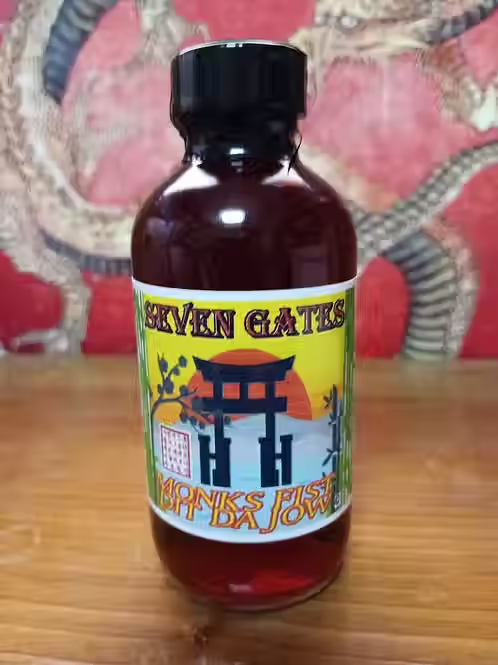
Illness and injury are legitimate reason to modify your training protocol. They should not be excuses to stop altogether. Modify but don't completely eliminate. One day off easily turns into two. Then into a week and a month, until you finally find yourself back at the starting line. Modification preserves a critical factor in training and that's your mind. Even with modified training your mind is still on the journey. When sidelined by illness, injury or even conflicting obligations there are remedies to keep your mind in the game. If ill to the point of flat n your back in bed, pick up a book on subjects related to your training. These could be martial arts, meditation, philosophy, history and dozens of others. Remember martial arts includes training the mind, body and spirit and the introduction of knowledge to the mind in any form is part of training. For minor to moderate injuries sustain use traditional herbal dit da jows and liniments helps reduce pain and speeds up recovery. For more serious or nagging injuries modify training to protect that part of the anatomy. I once had a serious shoulder surgery. I did not stop training and in fact was in the dojo 3 days afte leaving the hospital. No I didn't train in jujitsu, judo or any other form of training that could make things worse. I did show up everyday trained in irom palm on the other side and kicked the pole with feet and shins but in the end just showing up exercised the mind and spirit and kept them both in the game.
Increase intensity slowly
Don’t push too hard too fast regardless of which discipline you are training. Build up your training volume and force over weeks, months and years. You don't go into a weight room with little to no training and bench 450. It just don't happen. same is true for every other aspect of your personal training roadmap.
Rest and recover
When I say all in I do mean all in 100%. Part of all in is rest. The question is how much. During my formative years of training hard (25 to 40 years old) I trained very hard. Many years as much as 5 hours a day with teaching increasing that time. I trained 6 days a week. However, that did not mean I went full out in all aspects of my training , everyday. Some aspect require rest to be long term effective. Again weigh training is a good example. You simply don't train the same muscles every day and that's the beauty of a comprehensive martial arts road map. There are many other types of training to do in the interim. Give yourself time to recover from one form of training but do train in another form in the meantime. . Overtraining can cause damage and setbacks. multifaceted training can avoid this common problem.
These are just a few suggestions on how to keep yourself in the game long term. Like the saying goes, " Do it or do it not." Don't be a tourist, don't make excuses, don't take half measures, be all in.
Integrating a Multi Discipline protocol to Your Routine
Warm-up
Add hand conditioning exercises to your warm-up routine.
Post-training session
Use iron palm strikes after your main workout.
Dedicated days
Set aside 2-3 days a week for focused iron palm training but train some everyday.
Combine with herbal care
Use traditional remedies like Dit Da Jow to support recovery.
Track progress
Keep a journal of your training intensity, pain levels, and improvements.
By integrating multiple disciplines you'll gradually build stronger base of knowledge, a stronger warrior ethos and a completely new mindset without a significant disruption to your current schedule.
Unlock Your Full Potential
Multi faceted training is a time-tested way to enhance your martial arts skills. It builds powerful, resilience, strength and technique that can delver with confidence and precision. With patience, proper technique and a road map to success, you can become one of the elite.
Remember to train smart, use the right tools, and care for your hands and body with herbal remedies. Whether you’re a seasoned martial artist or just starting, this style of training offers benefits that go beyond the physical. It sharpens your mind, builds discipline, and connects you to a rich martial arts tradition.
Start your journey today and feel the difference in your strikes tomorrow. Your anatomy are your weapons - make them iron strong, disciplined and let your training take you beyond that initial goal yo set


Comments